Rio Celeste ToursIndependent Rio Celeste Guide Check Availability

Rio Celeste Tours: The Independent Comparison

This catalog reads and compares six Rio Celeste tours against the realities of Tenorio Volcano National Park. Daily entry slots are capped, swimming is banned inside the park, and heavy rain can wash the famous blue color out within hours. Every listing here states its price, length, rating and what is actually included, so you can match a day trip to your base, your budget and the weather without guessing.

Quick answer Swim ban, capped slots, the top pick and the cheapest way in

Swimming is prohibited inside Tenorio Volcano National Park, including at the waterfall pool, and daily entry slots are capped with a window that runs from 8 a.m. to 2 p.m. The strongest listing in this comparison is the Rio Celeste & Tenorio Volcano Hike: Blue River Adventure, rated 4.95 across 346 reviews. Listed prices run from $32 to $135. The cheapest way in is the reserved entrance ticket at $32, which covers only the self-guided trail. You then need your own car or a shuttle to the Pilón entrance near Bijagua. Every tour in this comparison offers free cancellation up to 24 hours before the start.

Key takeaways

The Rio Celeste Tours Worth Booking

This page reads the listings and puts the Rio Celeste tours in one place: three guided days from La Fortuna, two departures from the Bijagua side and the Guanacaste coast, and one self-guided entrance ticket. The from-price shown for each tour is the lowest adult shared-group rate on the listing at the time of the read. Extras can push that up, most notably transport on the Guanacaste combo and the slothland excursion. Two park rules frame every option here. Swimming is banned inside the national park, so the swim stops sold by some tours happen outside the protected section or at separate waterfalls. And entry slots are capped daily, which is why booking ahead matters. The tours below link to full write-ups with hours, inclusions, cancellation terms and group details.

Rio Celeste & Tenorio Volcano Hike: Blue River Adventure

4.95 across 346 reviews — the highest-rated full-day listing in this comparison, at a mid-pack price

★★★★★ ★★★★★ 5.0(346 reviews)· 8 hours

The highest-rated full-day hike at a mid-pack price: the complete trail including the waterfall, viewpoint, hot springs and mud pots, with lunch, all fees and taxes in the price. Departs from the quiet Bijagua side of the park.

Cancellation
Free cancellation 24 h

Rio Celeste Tours Side by Side

Read the rows left to right and the differences show up fast: where the day starts, how long it runs, what it costs and how reviewers scored it. The listed column is the lowest adult shared-group price on the listing. Figures current for Q3 2026.

Tour Listed Length Rating Departs Book
Rio Celeste Full-Day Tour from La Fortuna $89.00 8 hours 4.7 Morning hotel pickup, La Fortuna Check Availability Details
Rio Celeste Waterfall & Slothland Excursion $118.00 11 hours 4.97 Meet in Bijagua or request pickup Check Availability Details
Our pick Rio Celeste & Tenorio Volcano Hike: Blue River Adventure $92.31 8 hours 4.95 Meet at Sloth Park, Bijagua Check Availability Details
Rio Celeste Nature Hike & Swimming at the Blue River $95.00 8 hours 4.91 Hotel pickup, La Fortuna Check Availability Details
Rio Celeste Hike, Sloth Sanctuary & Llanos de Cortés Waterfall $135.00 12 hours 4.62 Resort pickups from about 6:20 am Check Availability Details
Rio Celeste Waterfall & Tenorio National Park Entrance Ticket $32.00 3 hours 4.14 Arrive at Pilón for your slot Check Availability Details

Live Availability on the Full-Day Tour

Powered by GetYourGuide

Guided Day or Park Ticket: Two Ways In

What a guided day actually adds

The drive from La Fortuna to the park takes about 1.5 hours each way on winding mountain roads, and a guided day takes that off your hands entirely. The Rio Celeste Full-Day Tour from La Fortuna picks you up at central hotels and hands you to a guide who walks the roughly four-hour trail with you, explaining the springs, the mud pots and the chemistry behind the color. Guides also spot wildlife you would walk past.

Sloths, tapirs and toucans live along the trail, and a second pair of trained eyes matters more than any brochure admits.

What the self-guided ticket asks of you

The Rio Celeste Waterfall & Tenorio National Park Entrance Ticket covers one thing: a reserved timed entry slot for the self-guided trail. You need your own car or a shuttle to reach the Pilón entrance near Bijagua, and you walk the loop on your own in about three hours. The official entry fee for foreign adults is US$12 plus 13% tax, about $13.56, so the $32 listed ticket is mostly paying for a guaranteed slot rather than the entry itself.

Trail signage is in English and Spanish.

Who suits the guided day

Choose a guided day if you have no car, if you want the drive handled, or if wildlife and interpretation are the point of the trip. It also suits anyone on a short itinerary who wants lunch, fees and transport settled in one price and one booking. Free cancellation up to 24 hours before start applies across the guided listings.

Who suits the ticket

The ticket suits confident hikers with their own wheels and a flexible schedule. You save money, you set your own pace, and you can go at the 8 a.m. opening to beat both heat and crowds. You give up the guide, the lunch and the door-to-door ease.

For many independent travellers that is a trade worth making, and the Rio Celeste Hike: Trail, Time and Tickets guide walks the trail section by section.

The judgment

If transport is solved, the ticket plus your own car is the cheapest honest way into the park. If it is not, a guided day is not a luxury, it is the practical answer, because there is no easy public route to Bijagua and the drive is demanding. That is the whole decision in one line.

Booking lead times, in plain terms

Dry-season mornings sell out first, and the daily entry cap is the reason. Guided days hold guaranteed tickets, so a booking a few days ahead is usually enough for them. The self-guided route works differently: reserve your timed slot as soon as the day is fixed, because walk-up entry at the gate is exactly what the cap can turn away.

Which Rio Celeste Tour Matches Your Day

You are based in La Fortuna

The Rio Celeste Full-Day Tour from La Fortuna is built for you. It is the most-reviewed listing that departs La Fortuna, with 698 verified reviews at 4.7, and the entrance fee, a local-restaurant lunch and central-hotel transport sit inside the $89 price. Reserve now, pay later, cancel free up to 24 hours before.

You want sloths, badly

Two listings deliver sloths. The Rio Celeste Waterfall & Slothland Excursion pairs the park hike with a sloth reserve at Bijagua, a coffee and chocolate farm and lunch, at 4.97 from 677 reviews, the highest rating in this comparison. Transport is arranged with the operator separately, with the listing mentioning a $70 per-person add-on.

The Guanacaste combo below also includes a sloth sanctuary if you are coming from the coast.

You want the highest rating

That is the Rio Celeste & Tenorio Volcano Hike: Blue River Adventure, our editorial pick at 4.95 across 346 reviews and a mid-pack $92.31. It covers the complete trail from the Bijagua side, including the volcano viewpoint, hot springs and mud pots, with lunch, fees and taxes included. You meet at the Sloth Park reception in Bijagua, so it works best if you have a car or a base nearby.

You want to swim

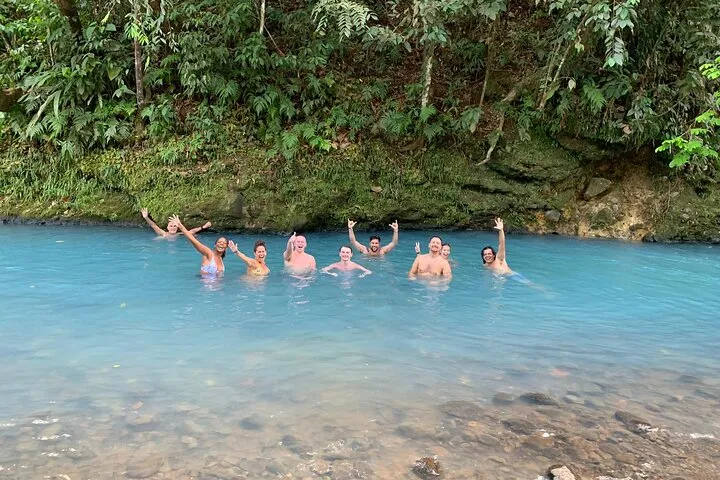
Swimming is banned inside the national park, so a swim day has to happen outside it. The Rio Celeste Nature Hike & Swimming at the Blue River hikes the park trail first, then stops for a swim at a river spot outside the protected section, with lunch, snacks and hotel transport from La Fortuna included for $95. The Guanacaste combo swims at Llanos de Cortés waterfall instead.

You are coming from the Guanacaste resorts

The Rio Celeste Hike, Sloth Sanctuary & Llanos de Cortés Waterfall is the only listing that runs the full day from the coast. It is a 12-hour triple stop: a swim at Llanos de Cortés, the park hike, and a sloth sanctuary, for $135 plus about $120 per person for shared resort transport. Some far resorts add more.

It carries the deepest review base here, 1,178 reviews at 4.62.

You want the lowest budget

The Rio Celeste Waterfall & Tenorio National Park Entrance Ticket at $32 is roughly a third of any guided day here. It buys a reserved slot on the self-guided loop, about three hours at your own pace. Bring your own transport, water and rain jacket, and read How to Get to Rio Celeste before you commit.

The Trail, the Falls and the Blue Chemistry

The loop

The standard route inside Tenorio Volcano National Park is a loop of roughly 3.5 to 4 km that takes most visitors 2.5 to 4 hours with stops. Expect stairs, mud and humid heat. Entry slots are capped daily and the entry window runs from 8 a.m. to 2 p.m., so an early start buys you a quieter trail and cooler air.

The waterfall lookout

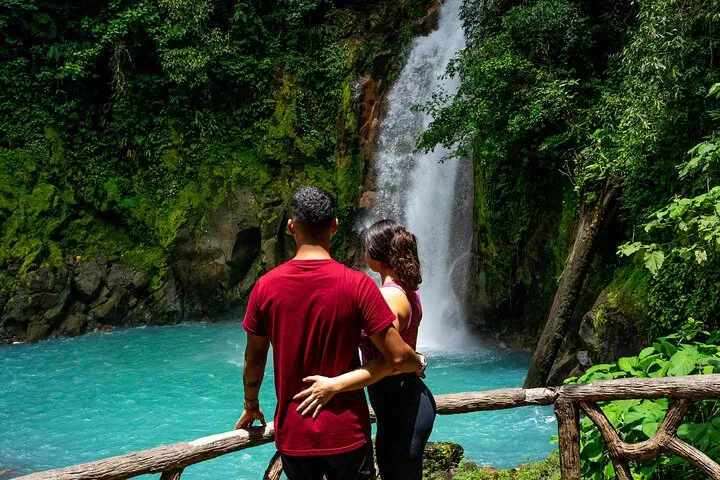
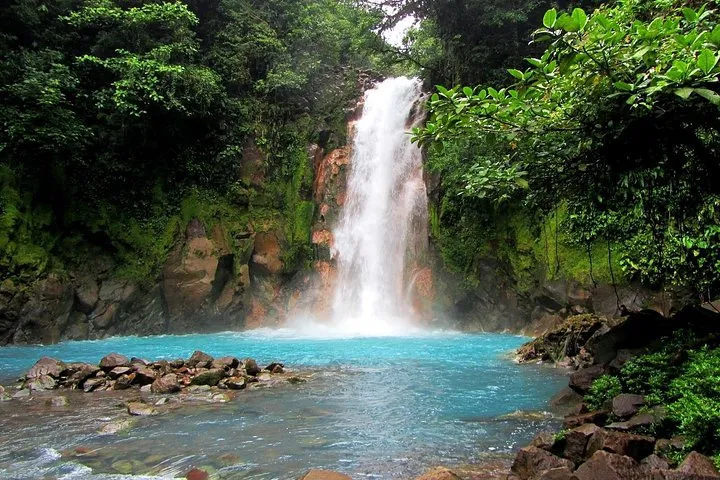
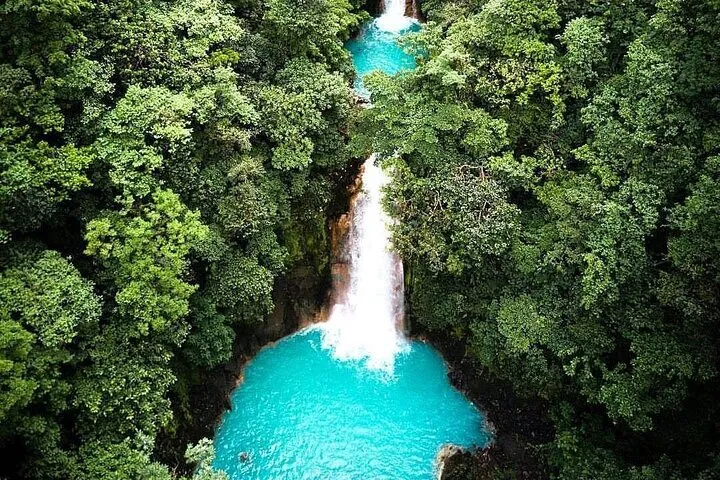
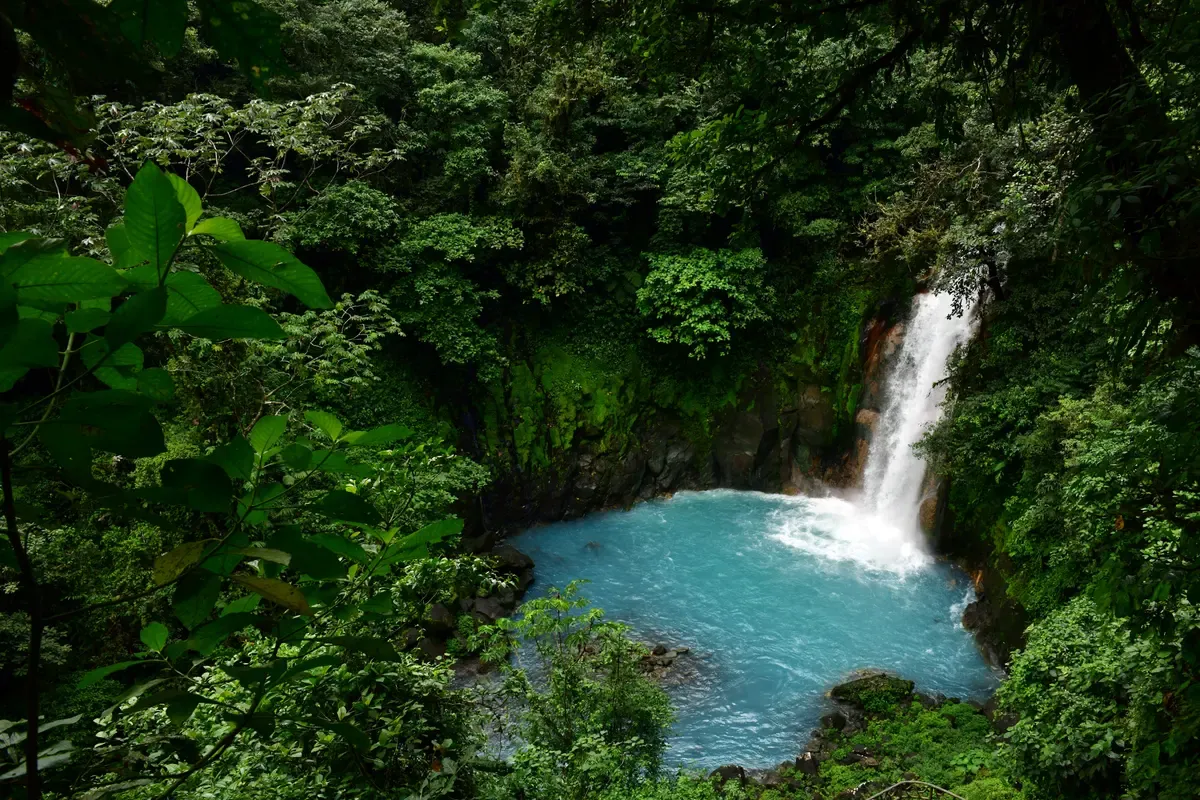
The signature stop is the Rio Celeste waterfall, seen from a lookout rather than from the pool below, because swimming is prohibited inside the park. The water pours into a chalky blue basin that photographs well even under cloud. This is the moment most of the day builds toward, and on the guided tours the guide times the group to reach it ahead of the midday rush.

Hot springs and mud pots

Further along the loop the volcanic character of the park shows itself. Mineral hot springs steam at the trailside and volcanic mud pots bubble and pop. The Blue River Adventure hike covers all of these in a single pass and explains what each feature says about the volcano under your feet.

Los Teñideros, where the color turns

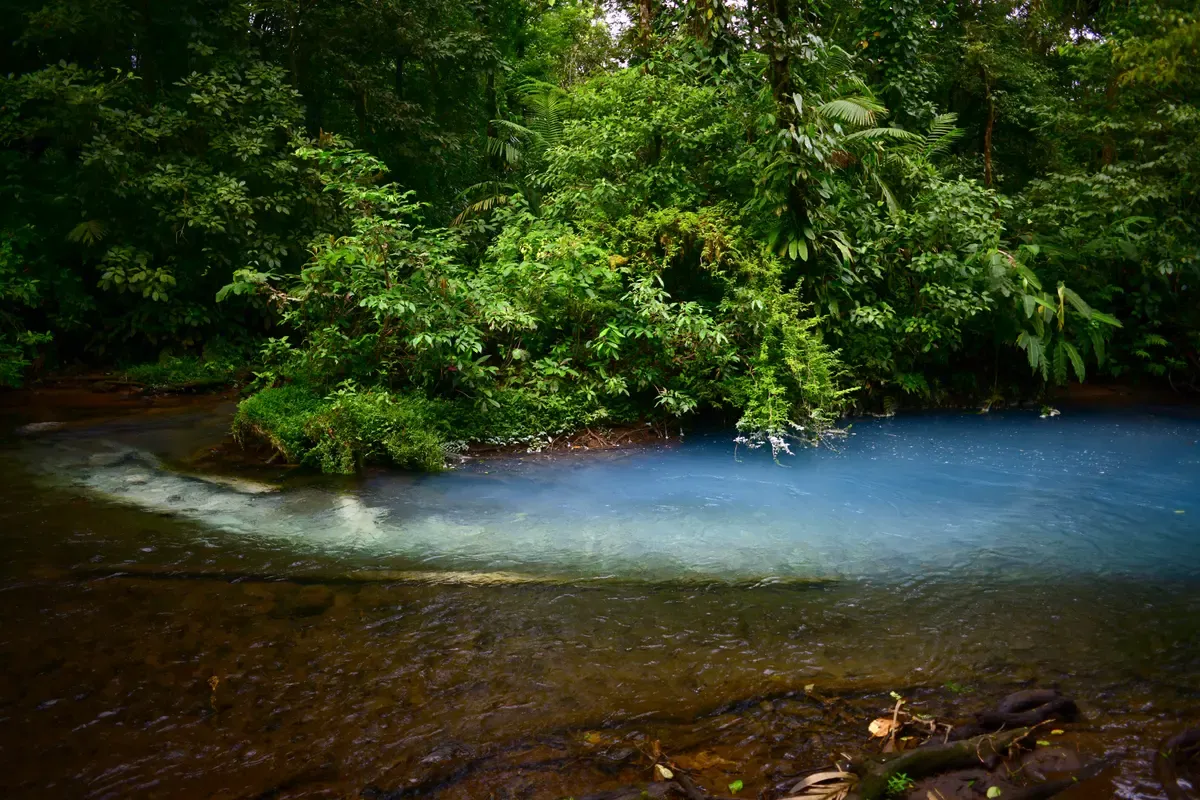
At Los Teñideros two streams carrying different volcanic minerals meet, and sulfur meeting calcium carbonate scatters light so the water reads an opaque sky blue. It is chemistry, not reflection, and seeing the two colorless streams merge into one blue river is the most surprising stop on the trail. SINAC, the national park system, publishes the park's details for anyone who wants the official account.

Wildlife, honestly

Sloths, tapirs, toucans, howler monkeys and poison-dart frogs all live in and around the park, and sightings are common but never guaranteed. One reviewer saw a tapir and called it a very rare opportunity. Go for the river and treat the animals as a bonus.

Glowing pale blue Rio Celeste river winding through dense rainforest in Tenorio Volcano National Park on a Rio Celeste tour, Costa Rica

The river holds its color downstream of Los Teñideros. Photo: Panegyrics of Granovetter, CC BY-SA 2.0, via Wikimedia Commons

What You Pay Beyond the Tour Price

The official entry fee

The official park entry for foreign adults is US$12 plus 13% tax, about $13.56, and children aged 2 to 12 pay $5 plus tax, according to SINAC, the national park system. Residents pay in colones. On every guided tour in this comparison that fee is already inside the listed price.

What the $32 ticket really is

The Rio Celeste Waterfall & Tenorio National Park Entrance Ticket is a reserved booking, not a bargain entry fee. The park itself would charge about $13.56 with tax. What the ticket really buys is the guaranteed timed slot, and that matters because daily entries are capped and dry-season mornings sell out.

Entry only, no transport, guide or lunch.

Transport extras

Two listings price transport separately. On the Guanacaste combo, shared round-trip resort transport adds about $120 per person on top of the $135 base price, and some far resorts add a pickup fee, so the real day cost approaches $255. On the slothland excursion, transport is arranged with the operator in advance and the listing mentions a $70 per-person add-on on top of $118.

Gratuities and snacks

None of the listings include gratuities, and the slothland excursion and the Blue River Adventure explicitly list them as extra costs. Bring cash in small bills. Bottled water is included on the hike-and-swim day, but the Blue River Adventure asks you to bring your own towel and water, so read the bring list before you go.

Costa Rica's tourism institute, the ICT, publishes general planning guidance for the country.

The Park Rules That Shape Your Visit

Entry slots are capped, and the day has a window

Tenorio Volcano National Park limits how many visitors it lets in each day, and the entry window runs from 8 a.m. to 2 p.m., according to SINAC, the national park system. In practice that means a full-day tour arriving mid-morning enters inside the window without any paperwork on your side, while self-guided visitors should reserve a slot rather than gamble on the gate. The trails close in extreme weather, and rangers do turn the trail around when conditions turn.

What the rangers ask of you at Pilón

The entrance checks identification, so every adult carries a passport or a copy. Costa Rica's park system also requires operators to register visitor details for each national-park entry, which is why guided tours ask for passport information at booking. Neither rule is decoration: the park caps numbers to protect the trail and the river, and the checks at the gate are part of how the cap is held.

No swimming, no drones, no pets, no picnics on the trail

Swimming is prohibited inside the park, including at the waterfall pool, and rangers enforce it. Drones are banned, pets are not allowed on the trail, and food is kept to the picnic area near the entrance rather than the loop itself. The swim listings in this comparison work around the ban honestly: they swim at Llanos de Cortés waterfall or at a river spot outside the protected section, after the hike is done.

What weather closes

Rain is part of the rainforest, and light rain does not close anything. What closes the trail is the extreme end: electrical storms and flood surges on the river. If a closure happens mid-day, tours typically substitute an extra stop or adjust the route, and the cancellation window on every listing here means a washed-out day can be rebooked rather than lost.

What the Day from La Fortuna Looks Like

The full-day tour from La Fortuna is the spine here, since it is the most-reviewed departure point in the catalog. Timings shift with traffic and weather, but the shape of the day holds.

  1. Morning hotel pickup in La Fortuna's central area, with the exact window confirmed at checkout

  2. About 1.5 hours by air-conditioned vehicle on winding mountain roads to the Pilón entrance

  3. Roughly four hours of guided hiking on the loop: the waterfall lookout, the hot springs, the mud pots, the Blue Lagoon and Los Teñideros

  4. Lunch at a local restaurant, included in the price

  5. The return drive through the hills, usually with a quieter bus and wet shoes

  6. Back in La Fortuna the same afternoon, with the evening free

Rio Celeste by Season: The Comfort Verdict

Verdicts, not averages: the trail is open all year, so the real questions are heat, crowd depth and how reliably the river reads blue. Dry months book out first and rain months carry flood risk that turns the water green-brown.

The Comfort Verdict, Season by Season

Read the chart as a booking decision rather than a climate lesson. The forest is open in every month, so the real trade is between crowd depth, afternoon heat and the odds that last night's rain is still in the river.

StretchMonthsWhat you tradeVerdict
Deep dry seasonJanuary to MarchSurest blue, thinnest streams, fullest trailBook 2 to 3 weeks ahead and take the 8 a.m. entry
Green-season shoulderMay to AugustLusher forest, lighter crowds, afternoon rainEnter early and you keep most of the day dry
Peak rainSeptember and OctoberFlood risk can brown the river or close the trailGo only with a flexible day and check park status first
Rains taperNovember and DecemberThe color returns and the trail empties, then holidays hitLate November is the quiet connoisseur's window

One line under all of it: the river's color is a weather question with seasonal odds, and the park caps how many people get to test those odds each day. Whatever the month, the earliest entry slot buys the cleanest read on both.

When the River Is Blue and When It Turns Brown

The chemistry in plain words

Two colorless streams meet at Los Teñideros. One carries sulfur, the other calcium carbonate. When they mix, the suspended particles scatter sunlight so the river reads an opaque sky blue.

Nothing is dyed and nothing is reflected. The color is a physical effect that needs clear, sediment-free water to work.

What rain does

Heavy rain turns the river green-brown within hours, because suspended sediment overwhelms the light scattering. The blue returns as the sediment settles in drier weather. Morning entries help for two reasons.

Rain in this region usually arrives in the afternoon, and an early slot puts you on the trail before any storm has had a chance to muddy the water.

What recent reviews report

The verified reviews are candid about this. One traveller wrote that recent rain meant the water was not as blue as it could have been, and still gave the day five stars for the guide. Another put it plainly: even though the river was not blue, the day was still a highlight of the trip.

The pattern repeats across the catalog. Rain mutes the color on some days and travellers still rate the experience at the top of the scale.

The verdict

Color is a weather question more than a season question. Dry months give you better odds, and When to Visit Rio Celeste maps them out, but a September storm can flatten a blue day and a July morning can deliver the best color of your trip. Book the early slot, keep expectations flexible, and go anyway.

Bright blue water of the Rio Celeste under rainforest canopy in Tenorio Volcano National Park, Costa Rica

Morning light on the bluest stretch of the river. Photo: Panegyrics of Granovetter, CC BY-SA 2.0, via Wikimedia Commons

Photography: Getting the Blue on Camera

The color photographs differently than it looks

The river reads an opaque sky blue in person, and that is exactly what a camera struggles with: bright midday sun puts glare on the water and flattens the color, while thin overcast works like a softbox and keeps the mineral blue saturated. If you can choose your slot, morning light on the waterfall lookout gives the deepest readings, and a drizzle in the frame often photographs better than hard sun.

Where the shots are

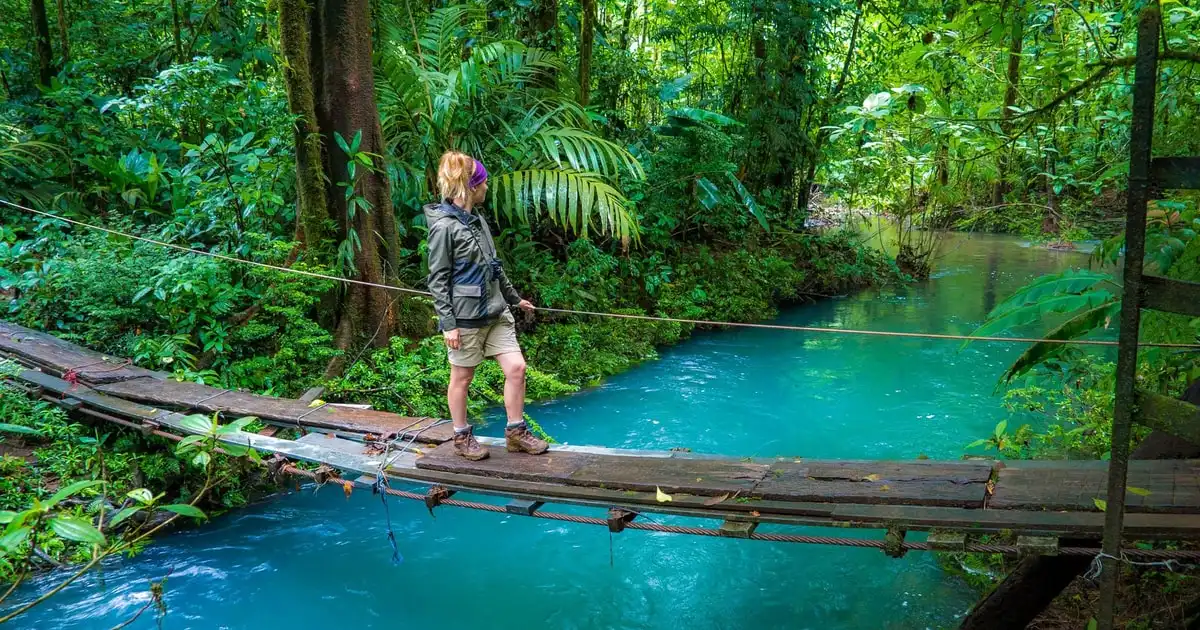
The waterfall lookout frames the full cascade from above the pool. Los Teñideros photographs as two ordinary streams meeting, which is exactly the story of the place, and the hot springs and mud pots give the loop its texture shots. The hanging bridge over the river downstream is the widest view of the color and the one that survives as the postcard frame.

The rules of the frame

Drones are banned inside the park, so aerial shots are off the table and rangers do enforce it. Tripods are impractical on a busy narrow loop, stairs hold up the line behind you, and the boardwalk rail is the honest rest for a phone. A polarizing filter is the one accessory that earns its carry on a sunny day, cutting glare off the water and pulling the blue back into the frame.

Pairing Rio Celeste With the Rest of Your Trip

La Fortuna hot springs and Arenal

The natural evening after a Rio Celeste day is a soak. La Fortuna's hot springs sit at the foot of Arenal volcano, and stiff legs from four hours of stairs and mud are a strong argument for booking one. Arenal's own trails and hanging bridges fill a second day if you are staying in town. Rio Celeste, Costa Rica: The Complete Visitor Guide sketches how the two areas fit into one itinerary.

Bijagua sloth stops and Llanos de Cortés

If you are driving yourself, the sloth reserves around Bijagua sit minutes from the park entrance and make an easy add-on after your hike. Llanos de Cortés waterfall, with its broad sandy swimming bank, lies on the Guanacaste side of the drive and is the swim stop the coastal combo uses. Both fit a self-guided day built around the entrance ticket.

Tubing and ziplines as a different day

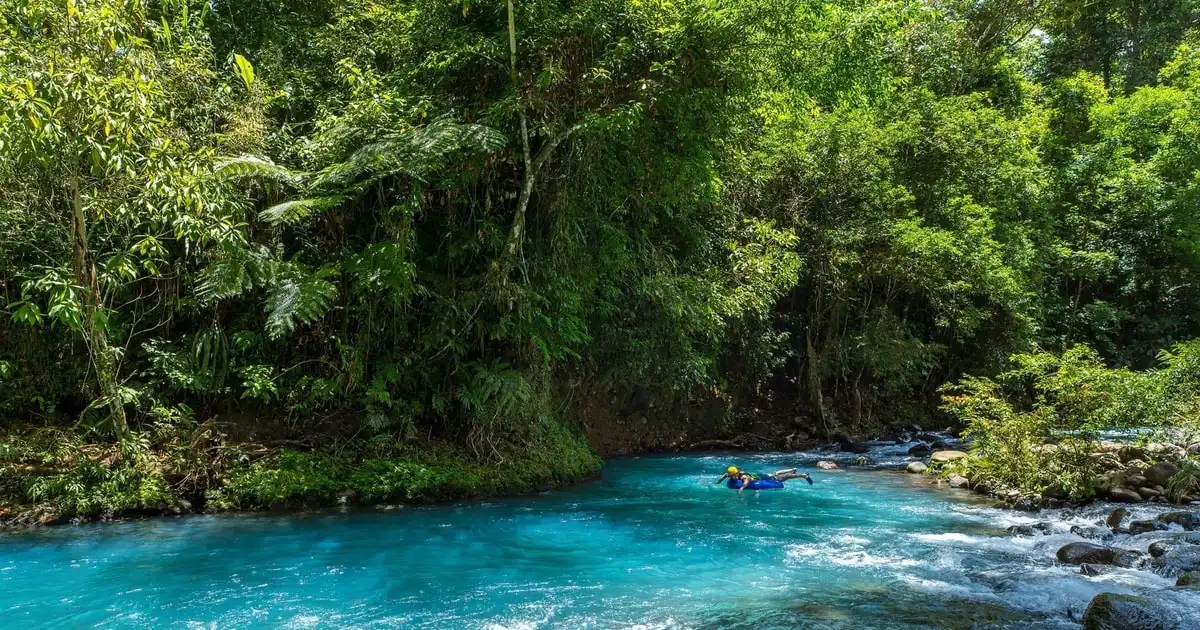
Tubing and zipline operators work the rivers and canopies outside the park. They are a separate outing, not an add-on to the hike, and the park itself allows none of it inside the boundary. Stack them on a different day, ideally from Bijagua or La Fortuna, and keep the park day clean and early.

Where to base yourself

La Fortuna has the hotels, the restaurants and the tour departures, at the cost of a 1.5-hour drive each way. Bijagua puts you ten minutes from the entrance, lets you take the first entry slot and suits the Bijagua-side tours such as the Blue River Adventure. Travellers chasing the river rather than the region should consider a night in Bijagua. How to Get to Rio Celeste compares the routes.

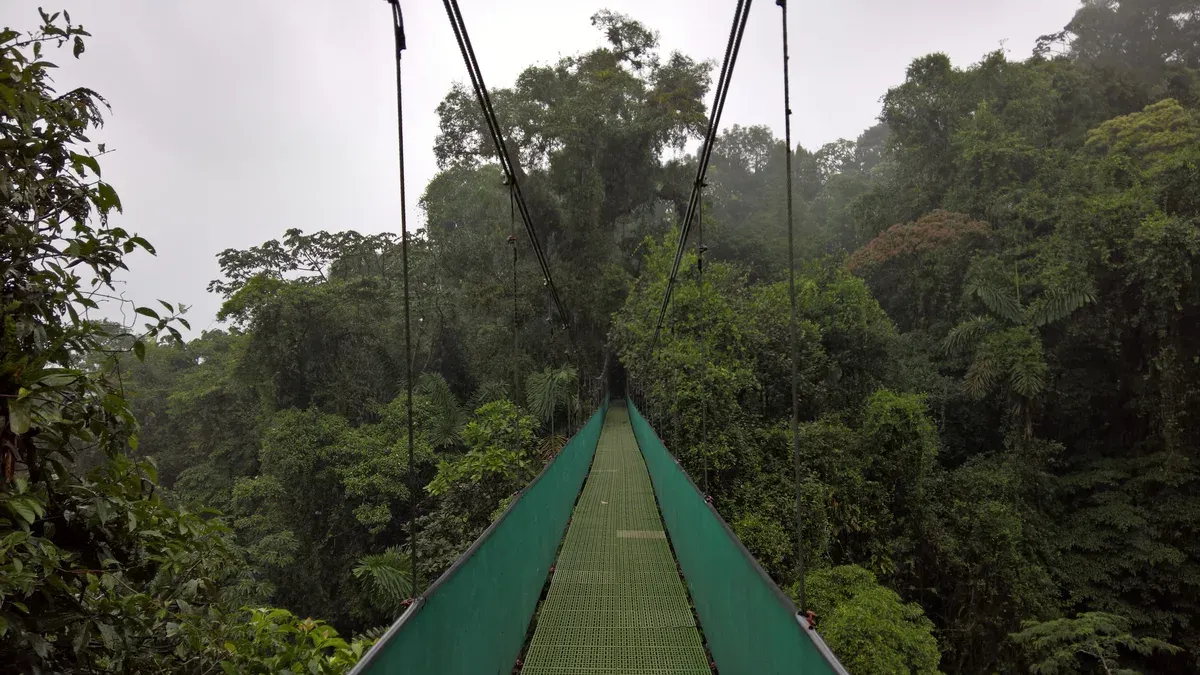
Hanging bridge over rainforest canopy near La Fortuna, Costa Rica, a common pairing with Rio Celeste tours

Canopy walks like this pair well with a Rio Celeste day. Photo: Alanthebox, CC0, via Wikimedia Commons

Rio Celeste With Kids and Older Hikers

What the trail actually demands

The loop runs 3.5 to 4 km with real stairs, wet roots and mud, and takes most visitors 2.5 to 4 hours with stops. None of the listings states a minimum age, so the honest measure is fitness and patience rather than a number on a ticket. A fit child who hikes at home will do fine.

A toddler in a carrier is a hard two-hour carry up stair sections in humid heat.

How the tours differ for mixed-ability groups

The full-day tour from La Fortuna and the Blue River Adventure both walk the complete loop at a group pace. The triple-stop day from Guanacaste splits the walking across three shorter stops, which suits mixed groups better than one long hike. The self-guided ticket is the most flexible of all: your own pace, your own turn-around point, and the waterfall lookout arrives early enough on the loop that a shorter day still sees the signature sight.

The easier alternatives beside the hike

Llanos de Cortés waterfall, which the Guanacaste combo pairs with the park, is a short walk down to a broad sandy bank and a swimmable pool, and it is the best low-effort waterfall day in this comparison. The sloth reserves around Bijagua are flat, shaded and slow, which makes them the easiest wildlife outing for grandparents and small children alike.

Timing the day around young hikers

The 8 a.m. entry window is the family cheat code. You finish the loop before the afternoon heat and the afternoon rain, the trail is emptier for the wildlife stops, and the drive back to La Fortuna ends before dinner. Every guided listing here runs the same morning rhythm, and the self-guided ticket lets you pick the first slot of the day outright.

What to Bring to Tenorio Volcano National Park

Documents and feet first

The entrance at Pilón checks identification, so carry a passport or ID for every adult in the group. The trail is rainforest: stairs, roots and mud are normal, and closed walking shoes with grip are the single highest-value item on the list. Sandals end the day early.

Weather kit

A rain jacket goes in the bag in every month of the year, because the forest can rain on any afternoon and the trail closes in extreme weather. Bring water for the loop, since it runs 2.5 to 4 hours and the humid heat is real. Swimwear belongs on the packing list only for the tours that swim outside the park, such as the hike-and-swim day or the Llanos de Cortés stop.

The checklist

Run down this list the night before and you will not be buying a poncho at the gate.

  • Passport or ID for entry
  • Closed walking shoes with grip
  • Rain jacket
  • Water
  • Swimwear only for the tours that swim outside the park
  • Cash for gratuities

What Travellers Say After the Hike

★★★★★ ★★★★★
It had been raining quite a bit, so the water wasn't as blue as it could have been. Santiago was a fantastic guide.
Brenden · United States · Verified booking review
★★★★★ ★★★★★
It was the highlight of the entire trip. Honestly, I feel like you get even more than what you pay for.
Laurie · United States · Verified booking review
★★★★★ ★★★★★
A long drive on winding mountain roads, but well worth it. We were fortunate enough to see a tapir, a very rare opportunity.
Luke · United States · Verified booking review
★★★★★ ★★★★★
Even though it was rainy, the Rio was not blue, and this was still a highlight of our trip.
Meaghan · United States · Verified booking review

Rio Celeste Tours: Questions Before You Book

Is Rio Celeste, Costa Rica worth visiting?

For most travellers, yes, and the review bases here back that up with 698 verified reviews on the La Fortuna full-day tour and 1,178 on the Guanacaste combo. The honest caveat is the drive and the weather, both of which Is Rio Celeste Worth It? weighs in detail.

How long does it take to hike to Rio Celeste waterfall?

The waterfall lookout sits on a loop of roughly 3.5 to 4 km that takes most visitors 2.5 to 4 hours with stops. The Rio Celeste Hike: Trail, Time and Tickets breaks the route down stop by stop.

How much does an entrance ticket to Rio Celeste cost?

The official entry for foreign adults is US$12 plus 13% tax, about $13.56, and children aged 2 to 12 pay $5 plus tax. The reserved entrance ticket listing costs $32 because it guarantees a capped daily slot.

Can you swim in Rio Celeste?

No. Swimming is prohibited inside Tenorio Volcano National Park, including at the waterfall pool. The swim stops sold on the hike-and-swim day happen at a river spot outside the protected section, or at separate waterfalls such as Llanos de Cortés.

Why is Rio Celeste blue?

Two streams carrying different volcanic minerals meet at Los Teñideros, and sulfur meeting calcium carbonate scatters light so the water reads an opaque sky blue. The complete visitor guide explains the chemistry and where to see the color change happen.

How do I get to Rio Celeste from La Fortuna?

The drive takes about 1.5 hours each way on winding mountain roads, and there is no easy public route. Guided days such as the full-day tour from La Fortuna handle the transport for you, or you can self-drive. How to Get to Rio Celeste compares the options.

When does the river actually look blue?

When the water is clear and sediment-free, which is most reliable in dry weather and on mornings before afternoon rain. Heavy rain turns it green-brown within hours. When to Visit Rio Celeste rates each month for color, heat and crowds.

Which Rio Celeste tour should I take?

The strongest all-round listing is the Blue River Adventure at 4.95 from 346 reviews. Base your choice on your starting point and budget, using the tours compared here.

Every tour here, one capped park, one page. Pick your day.

Free cancellation up to 24 hours before every listed tour.

Check Availability
Tours from $32 Check Availability