 Rio Celeste Tours
The Rio Celeste Hike: Trail, Time and Tickets
The Rio Celeste hike is a 3.5 to 4 km loop through Tenorio Volcano National Park that takes most visitors 2.5 to 4 hours with stops. You walk to a waterfall lookout, past hot springs and mud pots, to Los Teñideros, the spot where two mineral streams meet and turn the river an opaque sky blue. Entry costs US$12 plus 13% tax for foreign adults, about $13.56, and slots are capped daily, so you buy a timed ticket in advance online. The first stretch is flat and paved, then stairs drop to the waterfall. Swimming is banned inside the park. This guide walks the route stop by stop, explains how hard it really is, and covers tickets, hours and what to pack. If you would rather let someone handle the driving and the paperwork, the listings on the Rio Celeste tour catalog bundle transport, entry and a guide into one price.
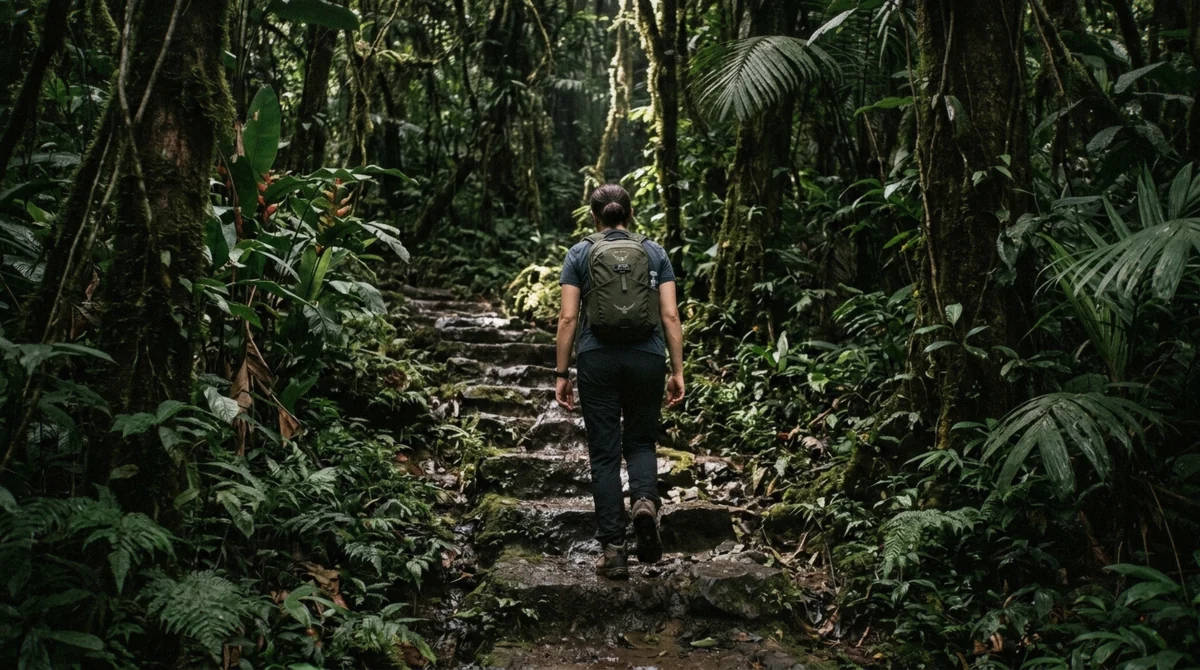
Stairs, humidity and shade: what the loop actually feels like.
Quick answer 3.5 to 4 km loop, 2.5 to 4 hours, timed tickets bought online, no swimming
The standard Rio Celeste route is a loop of roughly 3.5 to 4 km inside Tenorio Volcano National Park, and most visitors finish it in 2.5 to 4 hours with photo stops. Entry for foreign adults is US$12 plus tax, about $13.56, and the entry window runs from 8 a.m. to 2 p.m. with daily caps, so buy your ticket online before you go. The trail opens on flat paved ground, then a long staircase with a railing drops to the waterfall lookout. Swimming is prohibited inside the park, including at the waterfall pool.
Key takeaways
- Budget about half a day for the loop and reserve your entry slot ahead of time, since daily entries are capped
- Guided days with transport from La Fortuna or Bijagua start around $89, and the Rio Celeste tours with prices compared sit on one page
- Heavy rain can turn the river green-brown within hours, so color is never guaranteed on any given day
The Short Answer
The Rio Celeste hike is a loop of roughly 3.5 to 4 km in Tenorio Volcano National Park in northern Costa Rica. Most visitors take 2.5 to 4 hours with stops at the waterfall lookout, the hot springs, the mud pots, the Blue Lagoon and Los Teñideros. The single visitor entrance sits at Pilón, about 20 minutes from the village of Bijagua on a paved road.
The blue color is chemistry, not reflection. Two streams carrying different volcanic minerals meet at Los Teñideros, and sulfur meeting calcium carbonate scatters light into an opaque sky blue. That is also why the color can fail.
Heavy rain turns the river green-brown within hours as suspended sediment overwhelms the light scattering, and the blue returns as sediment settles in drier weather.
You have two realistic ways to hike it. Buy a timed entrance ticket online through SINAC, the national park system, and walk the trail yourself, or book a guided day that bundles transport, entry and a guide. The self-guided park entrance ticket lists at $32, while full guided days from La Fortuna or Bijagua run from $89 to $95.
Compare both on the page for Tenorio Volcano National Park: Hours, Fees and Trails.
The Route, Stop by Stop
The trail is signed in English and Spanish, and the loop links five main points. Here is the order you meet them and what each one is.
The flat approach
The first 20 to 30 minutes of trail are flat and paved, an easy warm-up through rainforest. The trails were rebuilt so they no longer turn to mud in rain, which is a real change from the old reputation of this hike.
The waterfall lookout
A long staircase with a railing drops from the main trail to the waterfall lookout. This is the postcard view, the river pouring into a blue pool, and it is the stop where most people spend the most time. The staircase is the steepest part of the hike, and what goes down comes back up.
The hot springs and mud pots
Further along the loop the volcanic side of the park shows itself. Mineral hot springs seep out of the ground and bubbling mud pots sit a short walk from the trail. You look, you do not bathe, since bathing is not allowed inside the park.
The Blue Lagoon
The Blue Lagoon is a wide, calm stretch of the river where the color reads at its most even. It is one of the most photographed points on the route and needs no detour, since the loop passes it.
Los Teñideros
Los Teñideros, the dyers, is where two streams carrying different volcanic minerals meet and the water turns blue in front of you. It is the scientific heart of the hike and the logical end point before you close the loop back toward the entrance.
If you are driving yourself, the park entrance sits at Pilón off the road from Bijagua. Routes and driving times from La Fortuna, Liberia and San Jose are laid out in How to Get to Rio Celeste: Routes, Roads and Times. One warning worth repeating here: maps apps often route a left turn too early off Route 4 near San Rafael de Guatuso onto the old road.
Continue to Samen before turning.
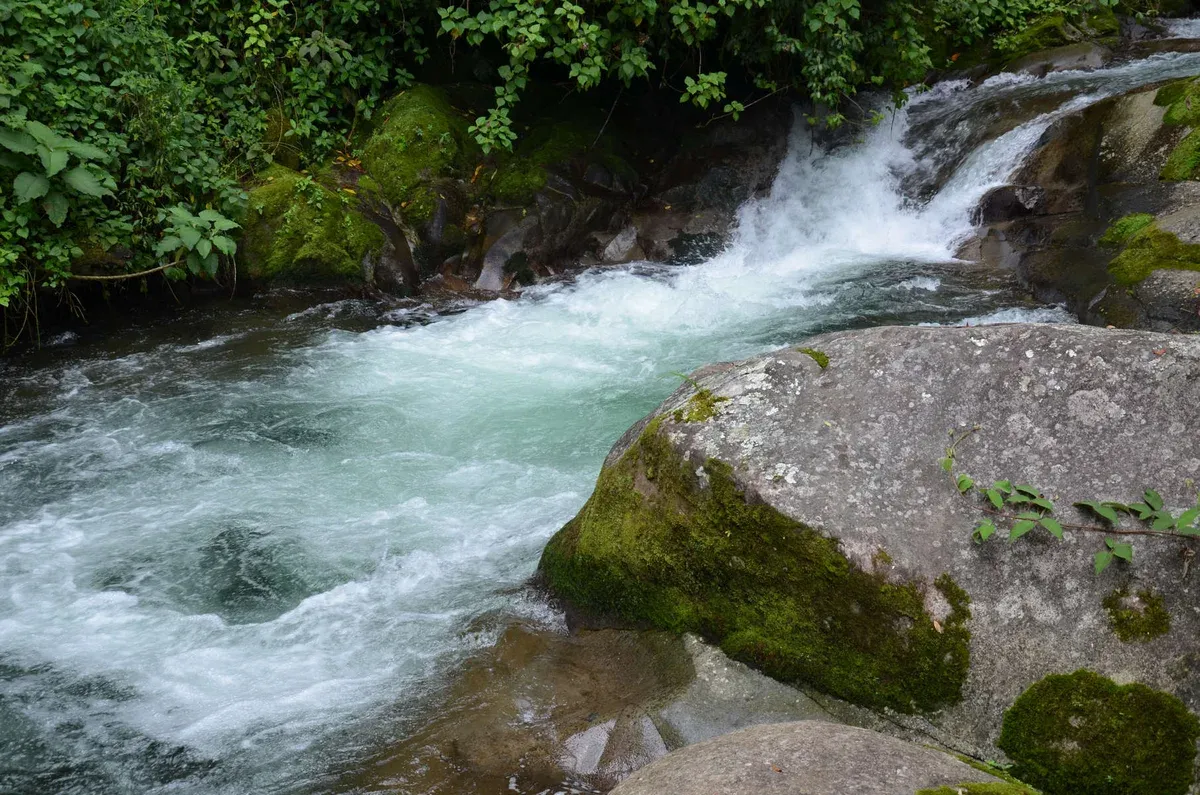
Laguna Azul, one of the fixed stops on the loop. Photo: Yasif89, CC BY-SA 4.0, via Wikimedia Commons
How Hard the Hike Really Is
On paper this is a moderate walk, not a climb. The loop is 3.5 to 4 km, the first stretch is flat and paved, and the rebuilt trails stay solid in rain. The two real challenges are the staircase to the waterfall lookout, which is long and you climb it twice if you want the view and then get back to the loop, and the humidity.
Guided listings rate the day as moderate across the board. The descriptions mention rainforest trail, stairs and humid heat. Temperatures in the area run between 24 and 31 degrees Celsius through the year, and the forest holds the moisture, so you will sweat on an overcast day.
Time on the trail varies with how you do it. Visitors on the self-guided ticket typically finish the loop in about three hours. Guided days budget three to four hours inside the park, because the guide stops to explain the geology and to look for wildlife.
Sloths, tapirs, toucans, howler monkeys and poison-dart frogs all live in and around the park. Sightings are common but never guaranteed. One verified reviewer on a guided day reported seeing a tapir, which the same reviewer called a very rare opportunity.
Wheelchair access is not offered on any listing in this comparison, and the reason is simple: stairs and unpaved trail. If stairs are a problem for you, the flat first section is pleasant but the waterfall lookout will be out of reach.
Tickets, Hours and Entry
Entry is where this hike differs from most walks in Costa Rica. Slots are capped daily, the entry window runs from 8 a.m. to 2 p.m., and tickets are bought in advance online through SINAC, the national park system. In-person sales at the gate are not guaranteed, so turning up and hoping is a gamble, especially in dry season.
These are the official entry fees charged at the park itself.
| Who | Official price |
|---|---|
| Foreign adult | US$12 plus 13% tax, about $13.56 |
| Children aged 2 to 12 | $5 plus tax |
| Residents | Pay in colones, rate not stated |
What the guided listings cost
If you would rather not deal with the SINAC booking or the drive, every guided option bundles the entry fee into its price. The comparison below shows the listings side by side. Guided days range from $89 to $135 per person depending on start point and stops, while the entrance-ticket-only listing sits at $32.
Two things stand out. The La Fortuna full-day tour at $89 is the cheapest way to get transport, a guide and lunch in one booking. The Bijagua entrance ticket at $32 is the cheapest way in at all, but it includes no transport, so it only makes sense with your own car or a shuttle.
Note that the Guanacaste combo adds transport as a separate cost, with shared round-trip transport adding about $120 per person on top of the base price.
| Listing | Start point | Duration | Price | Rating | Reviews |
|---|---|---|---|---|---|
| Rio Celeste Full-Day Tour from La Fortuna | La Fortuna | 8 hours | $89 | 4.73 | 698 |
| Rio Celeste Waterfall & Slothland Excursion | Bijagua | 11 hours | $118 | 4.97 | 677 |
| Rio Celeste & Tenorio Volcano Hike: Blue River Adventure | Bijagua | 8 hours | $92.31 | 4.95 | 346 |
| Rio Celeste Nature Hike & Swimming at the Blue River | La Fortuna | 8 hours | $95 | 4.91 | 174 |
| Rio Celeste Hike, Sloth Sanctuary & Llanos de Cortés Waterfall | Guanacaste | 12 hours | $135 | 4.62 | 1,178 |
| Rio Celeste Waterfall & Tenorio National Park Entrance Ticket | Bijagua | 3 hours | $32 | 4.14 | 146 |
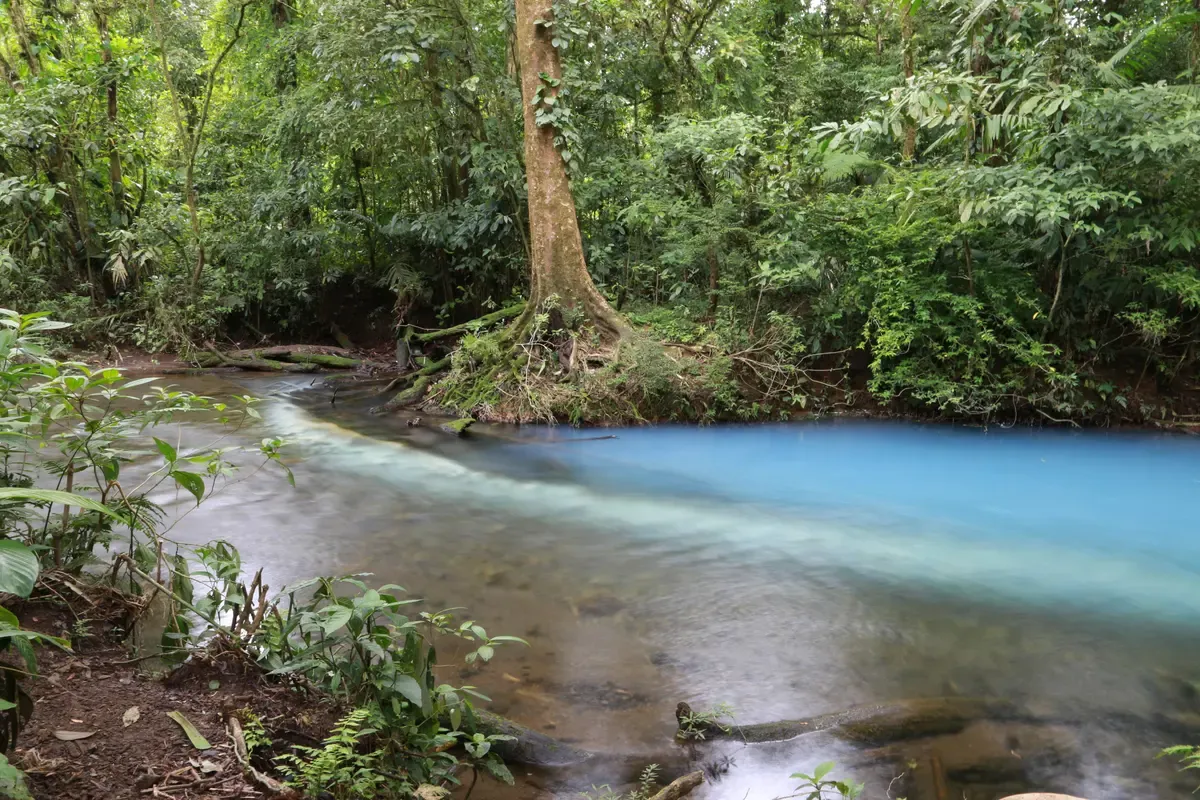
Los Teñideros: two ordinary streams, one extraordinary reaction. Photo: François Bianco, CC BY-SA 2.0, via Wikimedia Commons
What to Wear and Carry
This is a rainforest hike with stairs and heat, so kit is simple but matters. The listings agree on a short list of essentials, and the park adds a few rules of its own.
- Closed walking shoes with a grip, since the trail has stairs and can be slick after rain even though it no longer turns to mud
- A rain jacket, because afternoon rain is normal for much of the year
- Water, and on the guided Bijagua day a towel is listed as your own item to bring
- Passport or ID, required for entry at the park gate
- Swimwear only if your day includes a stop outside the park, since swimming inside the park is prohibited
The rules on the trail are strict. Swimming, drones and pets are not allowed inside the park, and food is banned on the trail on the self-guided ticket. If you want a swim, build it outside the protected section.
The nature hike with swim stop day finishes at a river spot outside the park, and the Guanacaste combo includes a swim at Llanos de Cortés waterfall, a known spot outside the protected section.
Hike Questions, Answered
The trail is open all year, so the real planning questions are heat, crowd depth and how reliably the river reads blue. The short version: dry months book out first and rain months carry flood risk that turns the water green-brown. The month-by-month detail lives in When to Visit Rio Celeste: Months, Color and Crowds, but three patterns matter for the hike itself.
Mornings beat both the heat and the tour buses, the green-season middle of the year combines lighter crowds with vivid river most days, and the wettest stretch brings flood surges and occasional trail closures, so check park status the day before.
Rain deserves a final word. Guides run rain or shine unless the park itself closes for floods or landslides, and reviewers are honest that rain mutes the color. One verified booking review notes the water was not as blue as it could have been after heavy rain, then still rates the day five stars, and another says the river was not blue and the day was still a trip highlight.
If a guaranteed electric blue is the only thing you will accept, aim for the driest months and take the earliest entry slot you can get.
The Loop in Wet and Dry Weather
The trail was rebuilt to drain, so the old reputation of a knee-deep mud bath no longer holds. In dry weather the loop is an easy-moderate forest walk, and the staircase to the waterfall lookout dries within an hour of the last rain. After a heavy night, the same staircase turns slick, the puddles re-form on the flat sections, and the river itself can run green-brown with sediment, which changes the payoff as much as the footing.
- Dry morning: full loop, surest color, busiest trail
- Light rain: thinner crowds, deepened color, careful footing on the stairs
- Heavy rain or storm: flood risk in the river, possible trail closures, brown water
The practical read: book the morning entry whatever the forecast, because mornings give you dry hours even inside the green season, and check the park's status the evening before if a storm passed through. The closure decisions belong to the rangers, and they err on the side of closing.
Photography on the Loop
The loop compresses its best frames into a short list. The waterfall lookout frames the full cascade from above, the hanging bridge downstream gives the widest river view, and Los Teñideros photographs as the moment two dull streams meet and the color begins. Overcast skies are the friend here: the mineral blue saturates under gray light and washes out under hard midday sun, so a gray-morning visit is not a compromise, it is the better light.
Drones are banned inside the park and rangers enforce it. A phone shoots the loop well if you keep the lens dry, and a polarizing filter is the one accessory that visibly earns its place on a sunny day.
Wildlife on the Trail: What You Actually See
The loop is a rainforest, and rainforests reward patience and eyes. In practice, most visitors see the poison-dart frogs working the leaf litter beside the trail, toucans and aracaris crossing the gaps, hummingbirds working the flowers near the entrance, and, if the morning is quiet, howler monkeys somewhere overhead. The tapir is the prize: it is shy, crepuscular, and regularly reported by the guided groups whose guides know the wallowing spots, and rarely by midday crowds.
Sightings are common but never guaranteed, and the honest framing is that the river is the destination while the wildlife is the dividend.
- Poison-dart frogs: near-certain, look at the leaf litter after rain
- Toucans and aracaris: frequent in the fruiting trees by the bridge
- Howler and spider monkeys: regular in the canopy, easier heard than seen
- Tapir: the prize sighting, most often reported on early guided walks
- Snakes: present and mostly shy; watch the trail, not just the canopy
A guide changes this arithmetic more than anything else you can buy. The listings in this comparison are worth reading for the wildlife hours alone: guides carry scopes, know the day's fruiting trees, and hear the birds before you do. Self-guided visitors can close part of the gap by walking slowly, standing still at the bridge, and letting the forest resume its noise.
Doing the Loop in Reverse Order
The trail is a loop, but most walkers walk it the same way, straight to the waterfall first. The alternative, continuing past the lookout to the hot springs, the mud pots and Los Teñideros before doubling back along the bridge, buys you two quiet hours at the color change after the first wave has turned around. Ask at the ranger station which direction the rangers prefer on the day, because maintenance and wet weather occasionally close one arm and turn the loop into an out-and-back.
- Standard direction: waterfall lookout first, then the springs, mud pots and Los Teñideros
- The quiet variant: push past the lookout early and reach Los Teñideros before the crowd
- Check at the ranger station: one arm sometimes closes for maintenance
Whichever direction, budget water for the whole loop: the humidity is the real distance, and the trail has no sales past the entrance. Two liters per adult is the honest number for a warm morning.
Hike Questions, Answered
What should I wear for the Rio Celeste hike?
Closed walking shoes, a rain jacket and light clothing you can sweat in. Bring water, your passport or ID for entry, and swimwear only if your day includes a river stop outside the park, since swimming is prohibited inside it.
How difficult is the Rio Celeste hike?
It is rated moderate. The loop runs 3.5 to 4 km, the first 20 to 30 minutes are flat and paved, and the main effort is a long staircase with a railing down to the waterfall lookout. Most visitors take 2.5 to 4 hours with stops.
Is the Rio Celeste trail marked?
Yes. The self-guided ticket listing states that trail signage is in English and Spanish, and the loop links the waterfall, hot springs, mud pots, Blue Lagoon and Los Teñideros in one marked route.
Where does the Rio Celeste trail start?
At the single visitor entrance to Tenorio Volcano National Park, at Pilón, about 20 minutes from the village of Bijagua on a paved road. There is no reliable public bus to the entrance, so you need a rental car, a shuttle or a guided day with transport.
Is the Rio Celeste waterfall worth it?
On a clear day, yes, and the review base agrees, with the two most-reviewed listings carrying 698 and 1,178 verified reviews at 4.73 and 4.62. The honest caveat is color: heavy rain turns the river green-brown within hours, and reviewers who saw a muted river still called the day a highlight. The wider trade-offs are weighed in Is Rio Celeste Worth It? An Honest Verdict. As for swimming, the river is safe to swim in only outside the park: inside the protected section it is banned, and the current near the falls is stronger than it looks.
When is the Rio Celeste trail quietest?
The park is at its emptiest when the rains taper late in the green season, while the dry months from the turn of the year bring peak crowds and holiday demand fills morning entry slots. Mornings beat the buses year round, and afternoon rain in the middle of the year thins the trail after midday.